When people explain their content marketing strategies, they brag about their social media plans, their videos, or their virtual seminars. They dream about starting a podcast or publishing an ebook. What they almost never talk about is email marketing.
It makes me crazy. As a business owner, one of the most valuable marketing assets you can have is an opted-in email address of a client or potential client. By opted in, I mean a person who took the leap and subscribed to receive your content. Basically, they’ve said, “Okay, market to me.” (You still have to earn the privilege with every single email you send. More on that later.)
So, why doesn’t email marketing get the love?
It’s not because it’s cost-prohibitive. Check out the estimated return on investment. For every dollar you spend on email marketing, you can expect to earn $36 in return, on average.
It’s not because it generates lackluster results. While you should always look to specific industry benchmarks to gauge your email campaign’s performance, the overall averages are compelling. Email messages reach 83% of the people they’re sent to. Across industries, around 37% of people open the email, and about 2% take an additional action in the form of a click-through. Ask any marketer. They are thrilled when their email strategies generate these types of results.
It’s not because people hate it. Actually, most of us – across all age groups – choose email as our preferred way to receive communication from a business.
I know what you’re thinking. We choose email because we can delete it or unsubscribe. Okay, now we’re getting somewhere. Here’s my point of view: Email marketing doesn’t get the love it deserves because there are so many people are out there doing it badly, or at the very least, without intent.
Yesterday’s approach to email won’t cut it
Email marketing is a craft. You have to put on your strategy hat and put some effort into it. The days of blasting out the same email message to zillions of people every few days and waiting for the leads to roll in are long gone. Your audience expects more from you.
Today, people give you their email address in exchange for content they value. That means it lines up with what you know about them – what they tell you by how they engage with your content and the actions they take to engage with your team through meetings, proposals, or purchases. As long as you continue to provide personalized, relevant information in an interesting way, your messages will continue to earn opens and clicks. If you don’t, all you’ll earn is unsubscribes.
Email is a piece of the puzzle
A good email is an integrated part of an overall marketing strategy, with different objectives, messages, and measures tied to prospecting, lead generation, and nurturing. Your messages do far more than simply promote your products and services. They deliver content full of insights, helpful tools, and valuable resources to your audience.
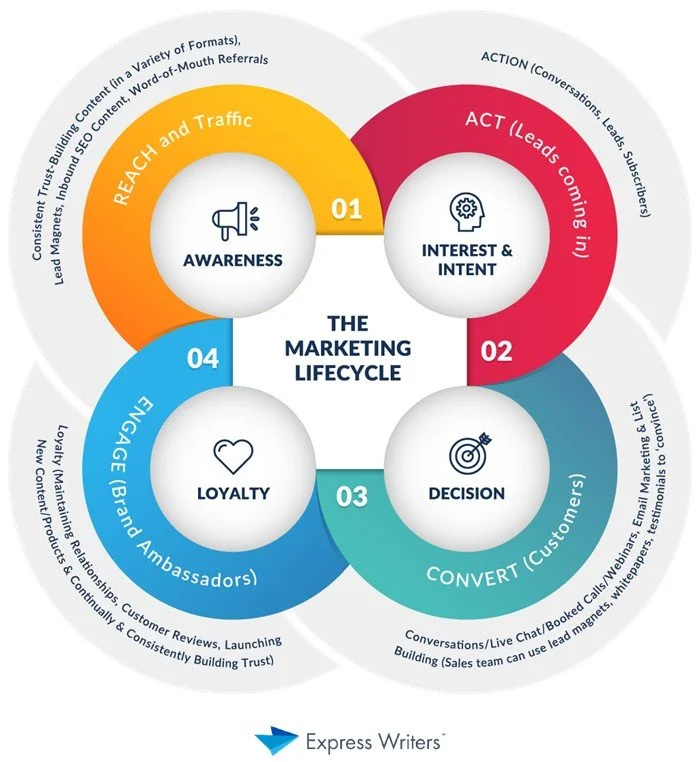
Today’s typical customer journey isn’t so much a linear funnel that starts with someone becoming aware of your solution, and then progressing nicely through the stages of interest, desire, and buying. Now, the customer journey is more of a cycle. Express Writers created a visual that shows a more holistic and customer-focused way to think about how your marketing and experiences engage your customers.
Email marketing is where it’s @
Look closely. There are key roles for email marketing to play throughout the cycle.
Awareness:
A solid content marketing strategy makes an effective centerpiece for engaging prospects and building awareness. Pair strong content with prominent subscription offers on campaign landing pages, and throughout your website. This way, highly interested prospects have plenty of chances to opt in to get more content sent directly to their email box.
Interest & intent:
Work your email list to nurture your budding customer relationships by continuing to provide relevant content on a regular – but not too frequent – basis. The frequency you choose should be based on your audience, your objectives, and your campaign results. There’s no hard and fast rule to follow. If you want a general benchmark, analysis by Campaign Monitor shows that every other week is a “sweet spot” for ensuring more people see your emails without driving up unsubscribe rates.
Decision:
As prospects move toward purchase, highly personalized email can play a central role. Build segmented journeys that trigger messages reflecting the actions a prospect takes – or doesn’t take. For example, when someone downloads a detailed “how-to” or buyers’ guide type of tool, take the opportunity to follow the action up with an email offering additional support, such as a customer case study and the opportunity for a complimentary consultation. The more you tailor the messages to demonstrate that you know the person and exactly where they are in their customer journey, the better.
Loyalty:
Email is absolutely essential for staying connected to your customers and continuing to expand the relationship. For me, email newsletters are the most valuable email strategy to strengthen relationships and create loyalty. When you invest the time to make your e-newsletter fresh, relevant, and fun, your customers will consider it a must-read. Think about the emails you get. If you’re like me, there are a handful that you open every single time. You can be that valuable resource for your customers. (And, don’t limit the e-newsletter to customers only. Let prospects sign up, too. Depending on your content strategy, consider whether you want to version the newsletter to further personalize the messages for prospect segments.)
Don’t treat email marketing as an afterthought. Give it a fresh look. Invest some time in rethinking how you can enhance and personalize it for prospect and customer segments all along their customer journeys. The ROI is real.
Need some creative inspiration for email campaigns that generate leads, trigger actions, onboard new customers, or build loyalty? Turn to Write Hand Ann.